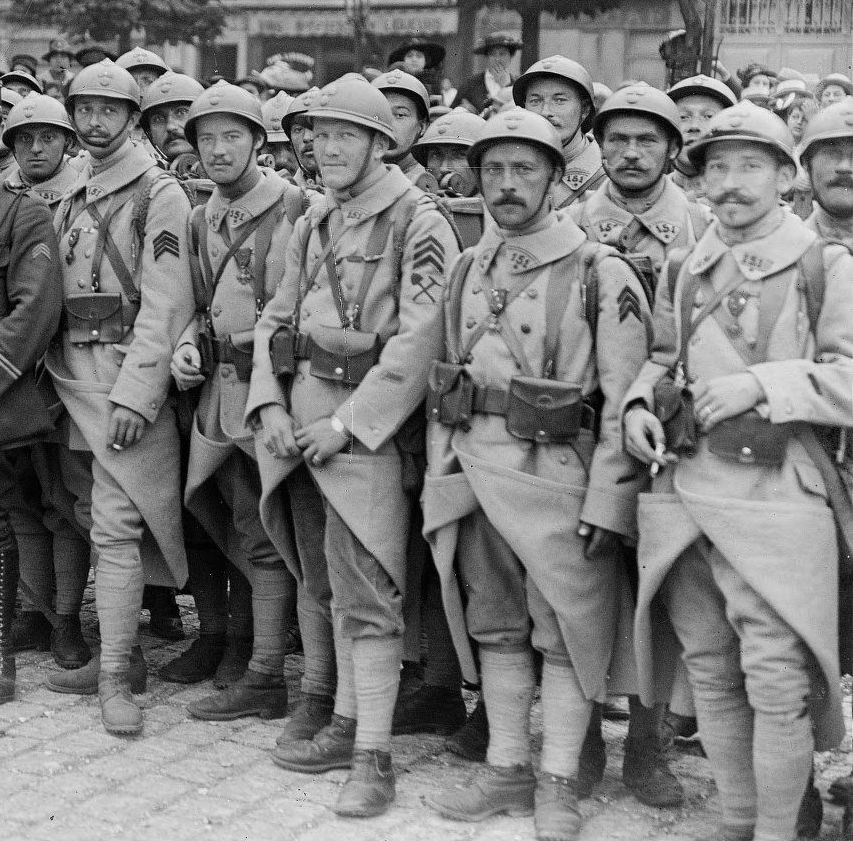
151e Régiment d'Infanterie de Ligne (1914-18)

Soldiers of the 151e R.I., ca. 1917-18
151st
Battle Acclaims


Medals


Citations


Pictures of the Regiment


The Regimental Colors


March of the 151st R.I.


First-Hand Accounts


Faces of the 151st Dead


  • In August 1914, the 151e R.I. is garrisoned at Verdun; 84e Brigade d'Infanterie; 42e Division d'Infanterie, 6e Corps d'Armée, IVe Armée (Ruffey).

    42e D.I.
    83e B.I.             84e B.I.
    94e R.I., 8e and 19e B.C.               151e and 162e R.I., 16e B.C.
    Compagnie 6/2 of the 9e Régiment de Génie (Engineers)
  • Assigned to 32e C.A. in October 1914, which it will remain in for the majority of the war. Attached to 42e D.I. from August 1914 to December 1916. Transferred to the 69e D.I. from January 1917 to November 1918.

  • 69e D.I. disbanded 15 January 1919, 151e reorganized into 84e B.I. and rejoined 42e D.I.

  • The 151e was composed of men primarily from the Meuse and Ardennes departments. However, when mobilized in 1914, its ranks were completed by men from the departments of the North, and the cities of Le Havre and Paris.

  • The regiment went by a number of nick-names including, the "Verdun Regiment" and (after the Battle of the Somme) the "Rancourt Regiment." However, "le Beau 15-1" or simply the "15-1" were perhaps more common.

  • The war lasted 53 months, with the 151e in action for all but six of these. Total casualties for the regiment were roughly 300 officers and over 16,000 men, of which over 100 officers and 6,000 men were killed.* In other words, the regiment sufferred a casualty rate of more than 600% (and a death rate of more than 200%) from 1914-1918.

    *Note: The 1919 historical cites the total number of casualties at 12,000, including over 5,000 killed. The above figure comes from the 1997 historical.


    Campaign History of the 151st R.I. - 1914-1918


    ~ 1914 ~

    14 July: The 151, along with the 42nd DI, conducts maneuvers at the Verdun training grounds in front of a nervous crowd of Meusians. The division prepares to depart for the Chalôns maneuvers camp as it does each year.

    28 July: While en route to Chalôns, the 151 receives order to proceed back to its barracks at Verdun (Miribel) and to place itself in a state of readiness for war.

    31 July: The 151 leaves Miribel and heads off to the Frontier (Lorraine) to help cover the border along with the rest of the 42nd DI. On 2 August, the general mobilization is decreed, and France and Germany are at war. The regiment is billeted at Marcheville, Pintheville and Ainville, small villages on the Woëvre Plain, for 15 days. It's put to work constructing defensive organizations in this area. With the invasion of the German 5th Army into France in the Ardennes forest, the 42nd D.I. is sent to check the advance. It is sent north to a position along the axis of Pierrepont--Baslieux--Doncourt.

    Battle of Pierrepont/Baslieux


    22 August: The 151 is placed as an advanced guard to the 42nd D.I., leaving Xivry-Gircourt at dawn in the direction of Saint-Supplet. Upon reaching Saint-Supplet, Colonel Deville orders the regiment to split into two forces: the 6th and 7th Companies move forward to Pierrepont in a northwest direction while the 5th and 8th Companies move northeast toward Boismont. At 0800hrs, the 2nd Battalion (6th and 7th Companies) comes under enemy artillery fire with German batteries located on Lartimont Ridge and German infantry in position in Doncourt Wood. The regiment advances into Goemont Wood and Grandchamps Wood, however it is forced to take cover in the face of the fierce artillery fire, which inflicts heavy losses in the ranks.

    At 0900hrs, the 7th Company launches a sortie in the direction of Doncourt Wood, reaching the objective and setting up position in the wood despite taking heavy losses. Meanwhile, the 6th Company makes an advance into Grandchamps Wood, it too suffering many casualties in doing so. With the officer cadre decimated, the order is given to fall back to Doncourt. At 0915hrs, the Germans counter-attack but their assault is broken once it reaches the French lines of defense, supported by the 61st R.A.D. (Divisional Artillery Regiment). The Germans fall back to the woods of Baslieux, Pierrepont, Tape and Doncourt.

    The 151 is positioned in Goemont, a part of Grandchamps and le Fayet, checking the enemy advance and holding in position. The order is given for the men to shelter behind their backpacks, but the the mess-kits and boilers strapped to these only make them easier targets with the sun reflecting off them. Behind Beuveille, elements of the 42nd D.I. are also engaged with German forces. The colonel commanding the 132nd R.I. left a battalion on the right of the 151 as reinforcements, since the latter had suffered such heavy losses. General Veraux, commanding the 42nd D.I., now attempts to reinforce his advanced guard mainly composed of the 151. He orders the 162nd R.I. forward, with one of it's battalions directed to proceed to Goemont Wood, one to Grandchamps Wood and the last to the southwest of Pierrepont, where it will spend the entire day fending off German attacks.

    The 94th R.I. occupies the ground northwest of the village of Boismont and makes it up to a point south of Baslieux and Bazailles. Around 1200hrs, combat erupts around Ville aux Montois, where the 94th is forced to fight on flat, open ground. Though suffering heavy losses, the 94th manages to check all German advances throughout the day. At 1300hrs, the German artillery destroys the Pierrepont railway station, as their infantry attack French positions in Grandchamps Wood and the village of Doncourt. The precise fire of German batteries force the French troops hugging the ground to dig shallow, individual shelters to protect themselves as shells continue to fall thick in their ranks.

    Sensing the weaking of the French defence, the Germans launch another counter-attack. The 8th Company of the 151 is annihilated in the attack (only 12 survive). Fortunately, the machine-guns of the 25th B.C.P. and the 162nd R.I. inflict heavy casualties on the German assault waves and repulse the counter-attack. At 1730hrs, the combat comes to an end; the 151 has lost 800 men. At 1800hrs, a final order is given, "les enfants baïonette au canon" ("fix bayonets kids"), in payment of respect to its dead. At the end of the day, the French remain in position on the line where they had started off the day, with the general German advance checked. However, with the withdrawal of the 40th D.I. and the 42nd D.I. subsequently threatened with encirclement, the 42nd is ordered to the west bank of the Othain River.

    Battle of the Marne


    29 August: After 48 hours rest, the 151 embarks by railway in the direction of Reims, arriving on 30 August. The 42nd D.I., now under the command of General Grossetti, is given the objective of protecting the withdrawing elements of the 4th Army in the area south of Rethel at the Retourne River.

    1 September: The 151 is given the mission of defending the passage of the Retourne at Esperance Farm. The regiment holds back the German forces all day but is then ordered to break off contact and yield ground.

    3-5 September: From the morning of 3 September, the 151 begins its retreat, billeting at Ay on the 3rd and Loisy en Brie on the 4th. At noon on the 5th, it reaches Villeneuve les Charleville, where it is ordered north to meet the enemy once again.

    6 September: At dawn the 151 faces the village of Corfélix and is ordered to attack Charleville. The 2nd Battalion bears the initial shock of the assault in violent fighting that degenerates into close quarter combat. The 3rd Battalion is also heavily engaged and successfully repulses five separate German attacks. At nightfall, Villeneuve and Charleville are in French hands.

    8 September: The 151 retakes the offensive, with the 3rd Battalion reaching les Culots and the 2nd Battalion taking the woods of l'Homme Blanc and the woods of the village of Corfélix. But the gains cost the regiment dearly: 600 men were lost in the fighting. The 151 is relieve in place by the 233rd R.I.

    9 September: The 42nd D.I., in order to parry an enemy movement, slides to the right and takes up position in the area of Fere Champenoise. It is a theater of fierce battle, of bloody hand-to-hand fighting where no mercy is shown. The Germans are checked on all fronts, and having suffered heavy losses, are forced to retreat.

    10 September: The French offensive is retaken once again. The 151, now greatly depleted, tails after the German rear-guard and captures numerous prisoners and material. The Germans are successively driven from the Connantre windmill, Connantray, and Fontaine d’Ivoire. In the evening, the 151 comes in view of Villeseneux. 300 meters from the village, the 3rd Company (in flank-guard), is met by a fusillade of bullets and shells. The regiment pulls back but is personally reassembled a few hundred meters to the rear by Col. Deville, who has come to see what has stopped their advance. The village of Villeseneux is strongly held by the enemy. The regiment, which has lost contact with the other formations of the 42nd D.I., is forced to halt it's progression.

    11 September: The 151 continues it's advance and seizes Villeseneux. Near Auberive, the regiment is engaged in seven days of violent fighting. But with the Germans dug in and heavy downpours slowing their advance, the regiment is forced to halt it's attacks and rests in place.

    21 September: Col. Deville takes command of the 84th Brigade and is replaced by Commandant Monphous.

    24 September: The 42nd D.I. is ordered to attack the entrenched German line north of Sillery. Despite several heroic and spirited attempts, the division is unable to make any headway and returns to it's original positions.

    Battle of the Yser

    19 October: After the 151 is given a rest for 4 days, it is sent (with the eniter 42nd D.I.) by rail to the north of France where it is needed to stem the German advance into Belgium. The 42nd D.I. is assigned to the Furnes [Veurne] area and the 151 is immediately thrown into the fight.

    22 October: With the Germans threatening to overrun Dixmude [Diksmuide] and the French marines guarding it, the 151 is ordered to advance on Lombaertzyde, while the 162 R.I. advances on Ramscapelle [Ramskapelle], Belgium.

    23 October: In the morning, under a violent artillery fire the 151 crosses the Yser River and canal in small groups over narrow pontoon bridges. Marching over sand which slows it's progress, the 151 approaches Lombaertyde [Lombardsijde] under fire the entire way. One battalion (under Commandant Dutour-Gauze) occupies it's emplacements and prepares to attack the village, while another battalion (Commandant Pascal) takes the Westende dunes. Despite the darkness and the relentless rain that transforms the ground into a shapeless amalgam, the Germans keep up their attacks. They launch ten assaults against the regiment's positions and each one is beaten back with not a foot of ground being yielded. Battalion after battalion are thrown at the 151. On two separate occasions, the 10th Company is encircled but manages to fight off the attackers.

    25 October: Dutour-Gauze's battalion, forced to pull back, is pressed up against the right bank of the Yser where the men dig rudimentary entrenchments. As high-tide comes in the water-level of the Yser rises and floods the shallow trenches. Despite the hardships, the men manage to hold onto their positions. Along the length of the front, the fighting has been merciless. The 42nd D.I. 25% of it's effective combat strength. However, the efforts of the 151 have allowed the Belgian engineers time to prepare for the intentional flooding of the German positions.

    27 October: In the morning of October 27, at high-tide, the old lock at Furnes silently lets the seawater drain toward the enemy lines already saturated by the rain. The German offensive in this sector relents.

    30 October: The 151 counter-attacks with the objective of retaking Ramscapelle, which was occupied by the Germans during the previous night. The village is successfully retaken, along with 400 prisoners. During the fighting, Commander Monphous is gravely wounded and is replaced by Commandant Bontin, who himself is wounded and replaced by Commandant Moisson from the 162 R.I. But the Germans had been checked and the German 12th Army became inactive.

    1 November: The 151 is once again in line on the Dixumde Road and carries out an attack in the Bischoote [Bikschote] sector. The 3rd Battalion seizes the village, but hit with a strong enemy counter-attack it is forced to retreat under a heavy artillery fire. The battalion is ordered to launch another attack and this time seizes and holds the area.

    10 November: After a violent artillery preparation with heavy shells, the Germans overwhelm the regiment's advanced-posts and breaks through the lines between the 2nd and 3rd Battalions. The situation becomes catastrophic. The 3rd Battalion is annihilated in place and the 2nd Battalion is overwhelmed. At night, what remains of the 151 is sent to the rear: the regiment has suffered more than 1,000 casualties, many from the class of 1914.

    19 November: Commandant Moisson is replaced from his temporary command by Colonel Dillemane.

    5 December: The 151 goes back up to the line on the Bischoote Road. But the general relief order arrives and the 42nd D.I. leaves it’s sector for the Ypres area where they await further operations. For 10 weeks, the 151 had fought almost without break in ferocious after ferocious battle, often poor supplied, their uniforms reduced to rags. Despite suffering appalling losses, morale held steady as the troops were determined to stop the Boche invasion and expel him from the soil of France at any cost.

    28 December: The 151 destroys the fortin (“small fort”) of Mamelon-Vert, near Zewartelen [Kwartellaan]. After a day of being stationed in the vicinity of Cassel , the 42nd D.I. embarks by rail to go on rest in the region south of Amiens. The 151 is billeted at Sains-en-Amiénois and Saint-Fuscien.

    31 December: The 151 parades in front of General Foch and January 1, Col. Dillemane presents the class of 1914 recruits with a flag, the only surviving bugler playing the traditional soundings. After eight days rest, barely recovered from their fatigue and still in shoddily clothed (their uniforms were in rags), the 42nd D.I. is sent to the Argonne forest as reinforcements.

    The Argonne


    15 January 1915: The 151 relieves the depleted 128 R.I. in the chaotic labyrinth of the Argonne, in the sector of Gruerie Wood, just north of Vienne-le-Château and la Harazée. Tightly packed pines, thick vegetation and innumerable steep ravines greatly reduce visibility and enhance the sense of claustrophobia. Mine warfare is the rule of thumb, along with quick, deadly raids and ambushes. It’s a very different experience from the flood plains of Belgium, or the rolling plains of the Marne. The snow, mud and cold also contributed to the daily hardships of life in the Argonne.

    The 151 is put into position at Fontaine-Madame and Blanlœil [Blanleuil]. From the first days that the regiment arrives, it is submitted to localized enemy raids.

    The Bois de la Gruerie in the of the Argonne forest. Just below the center is Blanlœil [Blanleuil] where the 151 was placed upon it’s arrival in the Argonne.

    1 March: Around 0700hrs, a strong German attack was made against the positions held by the 2nd Battalion. The assault is preceded by a short artillery preparation employing poison gas shells. The only defense the men had against this weapon were gas pads, as gas masks were not in distribution at this time. One company lost three officers and half of its effective in the assault.

    The months of April and May are passed in the same trying conditions and deplorable weather. General Deville is replaces General Duchene as head of the 42nd D.I., and Colonel Dillemane assumes command of the 151 with Lieutenant-Colonel Moisson.

    30 June: At 0400 hrs, the Germans opened the strongest artillery bombardment yet seen in the Argonne in preparation for a general attack. The bombardment, lasting several hours, incorporated a large amount of heavy guns and mortars and, for the first time, a massive quantity of poison gas. The gas pads that the French soldiers were supplied proved insufficient in offering protection against the gas. At the moment the attack was unleashed, some of the French machine-gunners had escaped the destruction. They opened up a murderous fire on the attacking German infantry, pinning them down and pushing them back to their original positions the following day.

    However, at other spots the German attack had made gains. One company of the 151 is completely wiped out and another badly mauled. In a supreme final effort, the original positions of the regiment’s first line is retaken. The three days of fighting cost the 115 dearly: 30 officers and 1,300 men were lost. Commandant Remy, wounded and taken prisoner, was killed with a bullet to the head -- a German brigade rendering him posthumous honors and citing him as an example of heroism.

    13 July: The Germans retake the offensive along the entire Argonne front. The positions of the 151 near la Harazée are hit at 1730 hrs. The Germans again rely heavily on poison gas, along with a new weapon of destruction, the flame-thrower. These cause terrible losses in the French ranks, which had yet to encounter this type of weapon. The 3rd Battalion of the regiment launches a counter-attack and wards off the encirclement of several neighboring units. The 2nd Battalion, following the 3rd, sweeps up many prisoners.

    14 July: Following a short period of calm that night, at dawn of July 14, the French launch a general counter-attack. Progress in front of the enemy’s machine-guns is difficult and the advanced grinds down.

    17 July: The 151 is finally relieved and is sent to the rear to regroup near Sainte-Menehould. In the seven months the regiment spent in the Argonne sector, the 151 lost 4,200 men.

    Next Page