Daily Rations
While a soldier was in the field, three types of rations appeared: normal, strong and reserve. The normal ration, was allocated during longer periods of garrisoning or for all other periods of war when the troops were not performing large fatigues. The strong ration was allocated during the course of operations and generally consisted of slightly larger helpings of each food item. Both normal and strong types were what were termed as "daily" rations: fresh food to be consumed on a daily basis. The vegetable and meat provisions were often provided together in a soup. The table below shows the general vivres du jour and their distribution amounts in 1916:
| Daily Provision(s) | Normal Ration [grams/oz] | Strong Ration [grams/oz] |
|---|---|---|
| Fresh bread or 'biscuited' bread [bread cooked for a long period of time that kept longer] |
750/26.5 650/23 |
750/26.5 650/23 |
| Fresh meat or Preserved meat [salted, smoked] Canned meat |
400/14 210/7.4 300/10.6 |
450/16 210/7.4 300/10.6 |
| Lard or salt pork [given only with fresh meat for cooking purposes] |
30/1 | 30/1 |
| Condensed Soup [given with canned meat] | 50/1.8 | 50/1.8 |
| Rice or Dry Vegetables [e.g. beans, lentils, peas, turnips] |
60/2 | 100/3.6 |
| Sugar | 32/1 | 48/1.7 |
| Coffee | 24/.8 | 36/1.3 |
| Salt | 24/.8 | 24/.8 |
| Wine or Beer, Cider |
1/2 liter 1 liter |
1/2 liter 1 liter |
| Tobacco [usually distributed in packets of 40 or 100g/ 1.4 or 3.5oz] | 15/.5 | 20/.7 |
Compared to today's standards, the notion of what constituted a nutritious diet was understandably different. But even compared to the food supplied to the soldiers of other armies in the war, the quality of that served in the French army was especially poor. The trench newspaper "Les Boyaux du 95e" wrote that the ration men made three round-trip journeys a day: “in the early morning, for coffee, spirits, bread; at ten o’clock, soup with beef (often corned); and in the evening, soup again, vegetables, coffee, meat (often grilled), the whole thing overly-cooked (there was emulation among the chefs).” Another soldier quipped: "GQG apparently didn’t have the leisure to take as much care over the supply of rations as they did about the supply of ammunition. They could perhaps have taken the time to taste the issue beans. Then we wouldn’t have wondered why they so often tasted of wet dog. They could perhaps have spared us heavily spiced meat and salted herring when men were already dying of thirst.
Despite its poor quality, army food was in fact an improvement in diet for many poor peasants. For these men, a daily supply of fresh meat (450 gm) and white bread (750 gm) was something not known before the war. Regardless, the quality and invariance of the diet was a constant, widespread source of complaint among the soldiers. Even after modest improvements made in the diet after 1917, made in response to the demands of mutinous troops, the nutritional value of the soldier’s meal would remain low throughout the war.
Soup
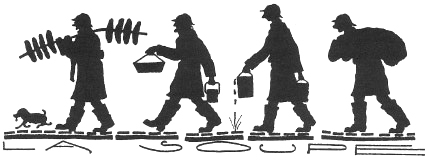
The mainstay of the French soldier’s meals was stew, which was always referred to as la soupe regardless of its ingredients or consistency. Alternately, a stewed casserole called ratatouille, or rata for short, would stand as the entrée. Soupe and rata were so prevalent in army life that the terms came to be used in a general sense to mean simply chow or grub. What went into the soup was whatever was on-hand. Generally, it was comprised of a meat base (beef or pork, or simply lard) with a couple vegetables, beans, or starches thrown in. Invariably this included some combination of white beans, potatoes, onions, cabbage, carrots, turnips, and split peas. Rice frequently was used as a starch and to a lesser extent pasta -- vermicelle, tapioca, macaroni, and various small pastas. If there were any spices added to the soup, a little salt and pepper would be tossed in. One solider described having on one day pea soup with pig lard and another, rice bouillon with beef. Henri Barbusse described it in the same way as countless other soldiers: "The main meal of the day, called 'soup' no matter what it was, consisted of meat, either with a rubbery lump of pasta or rice, or with beans, more or less cooked, or potatoes, more or less pealed, in a brown liquid, only just distinguishable from a slick of congealing fat that lay over it. There was no question of receiving green vegetables, nor vitamins..."
Jacques Meyer described the soup in remarkably similar terms as Barbusse, stating that: "La Soupe, was the generic term…it was a mix of meat, [called] "gristle," with pasta or rice forming a rubbery magma, or with white beans more or less cooked, or spuds more or less peeled, in a liquid brew which justified its name [of soup], although this assumed the form of a bed of curdled grease." Indeed, noticeably lacking from nearly all descriptions of the soup was anything that was sufficiently healthy or savory – no green or otherwise nutritious vegetables, and no spices for added flavor. Christian Bordeching, in a letter to his sister in February 1916, gave her a sample of his diet: "In the average week [we have] pea soup with pig lard twice, sweet rice bouillon twice, green beans once and rice soup with beef another." Emile Sautour also spoke about some soup he had been served in a letter from November 1915: "For food we have at 10 o’clock some bouillon which the taste of the tallow prevents us from eating drinking it and the beef stew. In the evening, some canned beef with spuds in sauce. Nothing is appetizing, and when you go on rest you are in the middle of the thickets [relieving yourself].
Bread
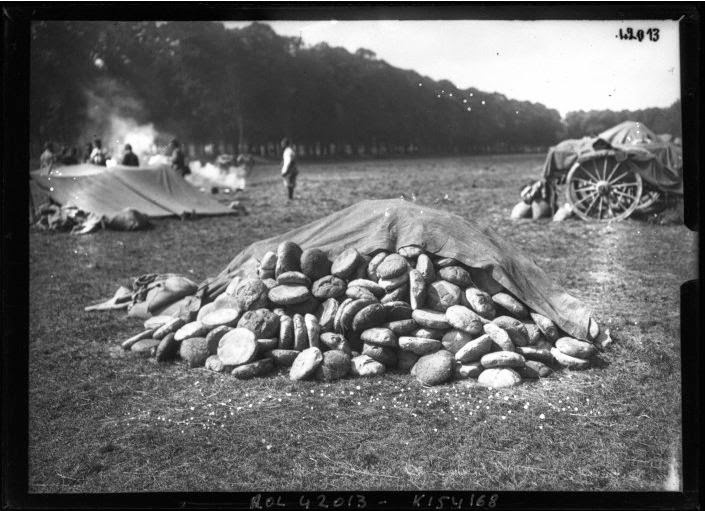
The bread was made in field bakeries at the division level. The Godelle oven constituted the foundation of the army bakeries. The oven used charcoal for heat and was collapsible to allow for transportation. It was composed of a metal framework on which was placed sheets of cloth, covered over with a bed of earth (10"-12" thick). The maximum production for one of these ovens was 2,200 lbs of bread per day. The loaf produced -- white bread with a thick outer crust -- was roughly 12" in diameter (weighing roughly 2 lbs) and resembled the round country loaf one finds today in French bakeries. The date of manufacture was imprinted onto the crust. It has been said that soldiers were lucky to receive bread within a week of its manufacture date.
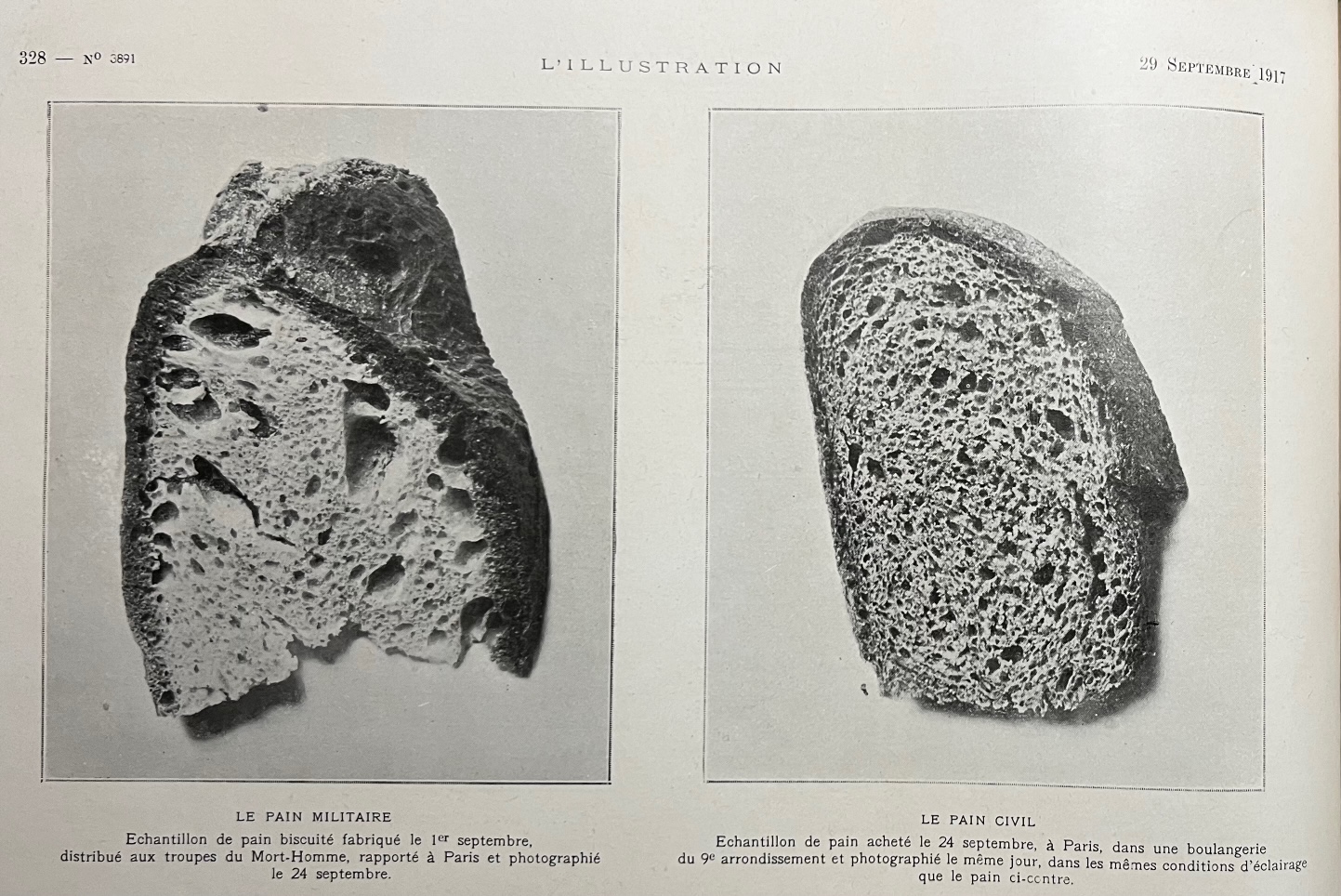
In the image above, a slice of the French army bread is shown on the left and compared to a civilian loaf purchased on the same day.
Meats
For the meat ration, early on beef was the most prevalent choice by the Quarter-Masters. By the second year of the war, pork had become the dominant choice. Less commonly, horse, rabbit and fish were all used as well. Ham, shoulders and roasts were preferred but the army couldn’t afford to be picky and many accounts from soldiers testify that the only signs of meat to be found in their soup were the occasional chunks of lard. They had various nicknames for the usually over-cooked or over-salted meat, including bidoche (“belly”), barbaque (“gristle”) and autobus (“the bus”). Demand outstripped the stocks that could be provided by French abattoirs and meat had to be imported from the United States, Brazil, Venezuela, China, Australia, North Africa, Argentine and Canada. This included beef, pork, horse, rabbit and fish. Beginning in 1915, pork becomes the more dominant meat distributed. Ham, shoulders and roasts were preferred but even lard could constitute a man's ration. Usually pork was served to the men roasted. To lower the risks of provisioning fresh meat, congealed meats, seasoned corned beef, dried or salted fish (usually cod) and canned fish (sardines and mackerel) were distributed. Raymond Escholier wasn’t a big supporter of salted cod: "[T]he brine never completely masked the taste of rot and the men were tortured with thirst at a time when they’d been reduced to a quarter [of a liter] of wine [a day] and had no drinking water." As it was, salted cod was not too commonly distributed. Canned foods (often heavily spiced) in a diverse stock were meant to replace the fresh meat distribution during the war. This included: beef with rice or vegetables, jellied cow tongue, salted cabbage and sauerkraut with ham, pork and beans, etc.
From 1915 on though, the French soldier's meat ration most often assumed the form of heavily seasoned canned pork (corned beef). The men quickly took to disparagingly calling it as singe, or "monkey," because of suspicious taste and appearance. Stringy and heavily salted, it was distributed in small round cans. Eaten straight from the can, it was the source of much derision and humor amongst the men. One poilu wrote in November 1917 this amusing editorial in the trench newspaper, “Le Pays de France”: ‘Monkey’: It’s a domesticated animal found in round, hermetically sealed cans. The monkey lives in there for years. Then one fine day, the squad cook opens the round can and sets it free. Alas! He doesn’t let him go frolic about, nor dream of female monkeys from long ago, nor recall the lush forests of his native Congo, nor imitate the gestures of men, or the fellas, [who are] his neighbors. Rushed into the pan, he is immediately fried. Unless the head-chef of the section hasn’t seasoned him with vinaigrette first. Anonymous monkey, he disappeared into a stomach, fell back into nothingness. And if anyone makes a face, it surely wasn’t the monkey but rather the soldier who ate him.
Vegetables and Produce
Theoretically, a soldier was supposed to receive 100 gm of vegetables per day. Particularly early on in the war, the vegetable most heavily relied on was rice. A new import from France’s Southeast Asian colonies, French soldiers did not take to it and notes to the Quarter-Masters asking for its replacement by other food items like lentils, peas, or beans were copious. Rice so commonly appeared in their meals that soldiers soon grew thoroughly tired of it. A joke went around which ran that the Germans could distinguish the French trenches by the thin band of white running along the parapet, the discarded remains of the soldiers’ rice portion chucked over the top of the parapet. Beginning in 1915 white beans and potatoes became the main substitute, followed to lesser degree by lentils and split-peas. Despite efforts to replace rice with alternative vegetables, the trench newspaper "La Saucisse" noted discontentfully in August 1916: "The basic meal…consists, morning and evening [of rice]. Our friends beg us to declare that a change would not displease them.
Later in the war, attempts were made to diversify the food supplied to the men. Quarter-Masters started distributing stocks of concentrated milk, split peas, lentils, pasta noodles, cheese, jams and fresh and preserved fruits and vegetables. Circumstances permitting, potatoes, sausage, figs, oranges, cheese, chocolate and jams were given out. In 1916, the breakdown of produce distribution over a period of 10 days was as follows: potatoes 4 out of every 10; dry vegetables (e.g. beans, lentils, split-peas) 2 out of 10; rice 2 days; pasta 1 day; and jam 1 day. The provision of fresh or canned milk was reserved, as much as possible, to the sanitary formations which regularly ran out. Butter and cheese (usually Camembert and Gruyère) were common as well. Sugar on the other hand was extremely limited during the war.
Tobacco
French regulation tobacco was of poor quality and somewhat badly processed, in that plant stems were not sorted out from the leaves. Specifically, it was air-cured "dark tobacco" (tabac brun). Light (i.e. blond) tobacco, typified by the Virginia leaf, only appeared with the arrival of the Americans (and was generally in cigarette form). Dark tobacco is typically used for cigars, pipes, chew and snuff, and is characterized by its strong, full flavor. The cut was referred to as the "Scaferlati" type in reference to its rough cut. Indeed, soldiers' accounts refer to chunks of stem being present, which is not all to surprising for those familiar with the less refined nature of your average pipe tobacco. All rationed tobacco was labele: "Armée Scaferlati pour les troupes." Despite it's rough cut, it was intended to be used both in pipes and cigarettes, and rolling papers were handed out for the latter. It was normally distributed in small paper cubes of 40 or 100 grams and referred to officially either tobac de cantine ("mess hall tobacco") or Gros Q ("Big Q"). The soldiers deformed this term to Gros Cul ("Bottom Ass"), as 'Q' and 'Cul' are pronounced the same in French. The 40 gm cubes were issued every other day while the the 100 gm cubes were to be distributed once every five. Cigarettes were not issued to the troops. Cigarettes could however be bought at the military bazaars and co-ops or from civilian shops, as could high-end tobacco, referred to as perlot ("refined") or fin ("fine"). Both pipes and cigarettes were popular, though the latter were more popular with the younger classes.
For more information on the Gros Q packets, go to the Tobacciana page.

Supplemental Foods
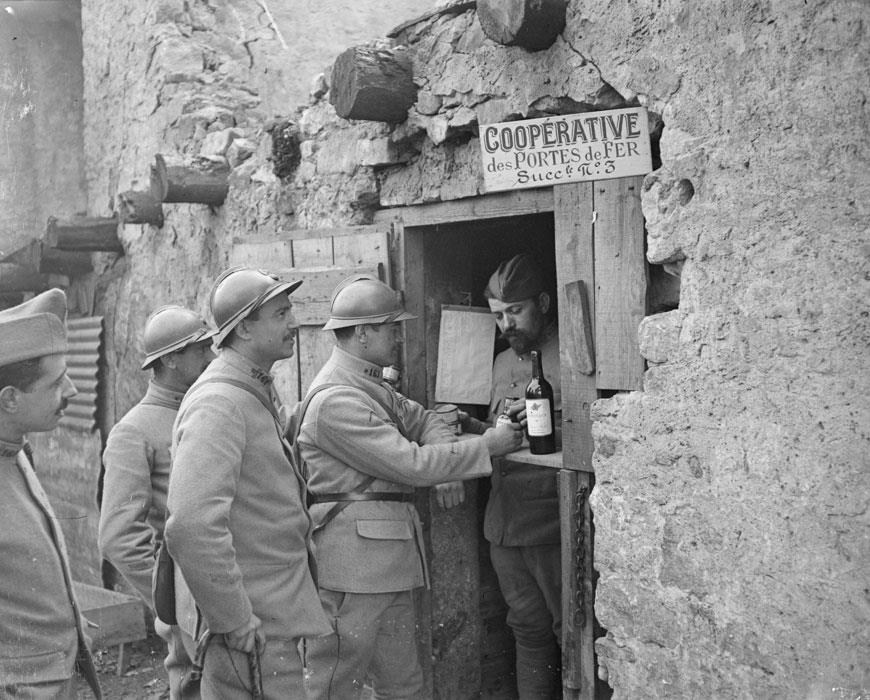
Soldiers could supplement their rations by purchasing food-stuffs from local farmers or businesses while in rear areas not evacuated or otherwise too remote. The prices, however, were often exorbitant and soldiers were thus limited to what they could buy with their measly salary (5 cents a day). To counter this, the Quarter-Master progressively established truck-bazaars, small shops (for ordinary rations) and co-ops (a mix between a saloon and a PX). These co-ops allowed soldiers to find in one location a variety of produce and knick-knacks. The items most often sought were wine, Gruyere cheese, white beans and sardines, along with fresh vegetables. The only other supplement for the soldier's dreary diet was the possibility of an occasional food package sent from home. When such a gift basket did arrive, it was the cause of much celebration for the fortunate poilu and his close mess-mates. Items could include marmalade, jam, fruits, biscuits or bread, cakes, chocolate and sweets. Parcels filled with such rare delicacies were too few and far between for most soldiers.