



First Hand Accounts of the 151e R.I.
Sob-Lieutenant Raymond Jubert
(Private Jubert, 91st R.I., before being transferred to the 151st.)
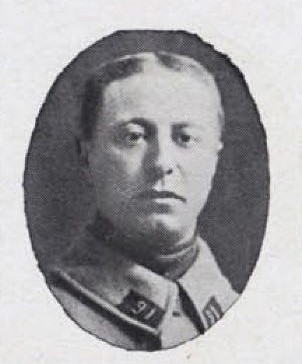
Raymond Armand Alexis Jubert was born 5 November 1889 at Charleville (Ardennes) to Ernest and Nathalie. He had never served in the military prior to the war. He had received an exemption from universal service in order to study law to become an attorney. Yet when the call went out for mobilization, he voluntarily enlisted in September 1914 at the age of 25. First serving with the 91st R.I., he received a promotion to aspirant ("junior officer") and a transfer to the 151st R.I. in April 1915. His baptism of fire with the "Quinze-Un" (151) was in the forests of the Argonne, where he received his first wound on 1 July 1915 with a bullet in the right foot and eleven grenade fragments in the right arm. He would also lose his younger brother, Maurice, in the Argonne. A corporal in the 91st R.I., Maurice disappeared in the Bois de Boulante on 13 July only short distance from where Raymond had been wounded. Maurice's body would never be recovered.
In November 1915, he was promoted to Sub-Lieutenant. Jubert distinguished himself at Verdun in March, April and May 1916, and again during the attack on the Chemin-des-Dames in April 1917, where he would be shot again this time in the left arm. During his three years of service with the 151, Jubert would receive citations in the Orders of the Division and Army Corps, along with two more in the Orders of the Army. He was the recipient of Chevalier de la Légion d'Honneur and the Croix de Guerre with two palms, and stars of vermilion, gold and silver. His Legion of Honor citation read:
"Brillant officier, of high moral valour, a true leader of men, proven himself in the Argonne, Verdun and the Somme for his gallant conduct under fire. Twice cited in dispatches: on 16 April 1917, brilliantly led his section in the assault, wounded, nevertheless continued to lead the progression and did allow himself to be evacuated until after received orders."
The 151 would be sent back a fourth time to Verdun in August 1917 to take part in the French counter-offensive on the Right Bank of the Meuse. Jubert was killed 26 August 1917 after leading his men in an assault in the Bois des Caurières (Ravin de l'Ermitage). Last seen at the objective, Tranchée Bois de la Chaume, his body was never recovered. He was 27 years old. Like his brother, Raymond has no known grave. His name has been inscribed on the memorial plaque in the Saint-Rémi Church as Charleville-Mézières and on the Monument to the Dead in town. It was during his time recuperating from his wound received at the Chemin-des-Dames that he completed his memoirs. Before being sent into "the Furnace," idealism and nationalistic themes can be clearly seen in his letters. After only a few days in the battered trenches of the infamous Mort Homme, disillusionment, shock and terror have ravaged Jubert.
The following account is taken from Jubert's memoirs, which were begun at Verdun in 1916 and finished before his death a year later. He was assigned to the 11th Company (3rd Batt.).
I. Feb. 26 to March 29, 1916:
Côte de Froide-Terre, Bois Nawé/Carrières d'Haudraumont
II. April 1916:
Le Mort-Homme
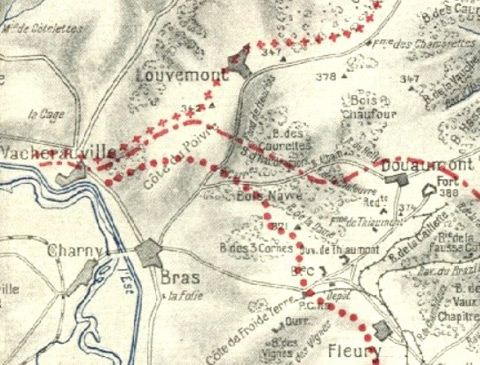
Detail of the 151sts sector on the Right bank at Verdun. To the left [west] of Douaumont village is Bois Nawé; above it, Bois d'Haudraumont and Bois des Caurettes blanket the slopes of the Haudraumont Heights. Côte Froide-Terre is at the bottom center.
The regiment is on rest in Vitry-le-François (about 40 km due west of Bar-le-Duc) when it is ordered to Verdun, roughly 65 km away.
After a long forced march through snow squalls and rain showers, freezing temperatures and struggling over muddy roads, the regiment arrived at Verdun on the night of March 9. It is to relieve the severely battered 39th D.I. General Deville (commader of the 42nd D.I.) holds a meeting with all the officers of the 151st at the town hall. In a broken, ill-tempered voice, Deville addressed the exhausted yet composed crowd in grim terms:
"Sirs, Verdun is threatened. You are at Verdun and you are the Verdun Brigade. I won't hide the truth from you; we've been caught by surprise...I won't hide the mistakes from you; we must fix them...The situation was desperate; it still is unresolved. The sector that we're taking up? Chaos...This life which awaits us? Combat...The trenches? They don't exist...Don't ask me for material: I don't have any...Reinforcements: there aren't any...Good luck, sirs!"
With that, General Deville departed, leaving his audience in a chilled silence. A short while later, with the regiment assembled, the men departed Verdun as canons thundered all around. As the column passes through the ruins, the glow of fires lights the way through the darkness. Jubert records the scene:
"We've crossed the Meuse -- broad, noisy, sinister -- its moving, bloody mirror flowing by the last blazes...This procession of shadows departing from the ruins of the ghost town, this silent army of spectres marching toward the canons, had a Dantesque grandeur."
The regiment encounters their first shell burst when they reach Fort Belleville. At this time, snow began to fall again. 3 km further on, from the Belleville Heights, Jubert can see the neighboring villages of Bras and Charny in front, and to the east, Fleury. A blanket of snow covered the ground and shone pink in the night, reflecting the flickering glow of the bombardments, the blazing fires and the descending flares. Jubert's company (11th) is held in reserve on the Côte Froide-Terre ("Froide-Terre Hill") as other elements of the regiment are sent forward to the first lines in Bois Nawé ("Nawé Wood") and the lower slopes of the Haudraumont Heights [Carrières d'Haudraumont or "Haudraumont Quarries"], behind the Bras-Douaumont Road (about 2 km due north). The Germans occupied the crest of Haudraumont Heights.
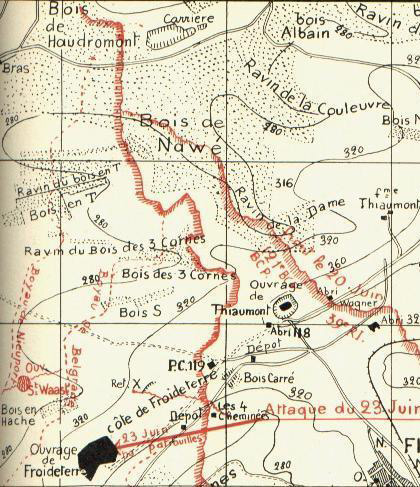
Appearing on the top edge of the map is Bois d'Haudraumont and the Carrières d'Haudraumont. The Ravin de la Couleuvre and de la Dame are located on the right [eastern] border of Bois Nawé. The Ouvrage ["fort"] de Froide-Terre is at the bottom left.

Map showing the 151 RI sector, taken from the 151 JMO.
Jubert takes up a shelter made of sticks, with a few shovelfuls of earth thrown on top and a tent-canvas for a door. Falling asleep for several hours, he was rudely awoken by three 150s which landed only 15 meters away. Jubert reasoned that since both daylight and rain pass through with ease, shrapnel shouldn't have any trouble either. For several days, their positions remain under fire.
"These daily bombardments served as a lesson. We were under the eyes of the airplanes. The hawk, after spotting us, throws down a thunderbolt. We learned to hide ourselves out of view...security became the law of the land. The blood of the victims, which continued to spread further each day, wrote this lesson out on the soil. Hurry! Carelessness and laziness had taken the form of suffering and death all too frequently..."
On one day, Jubert and his men watched, fascinated, as a French observation balloon (or "sausage" as they were referred to) snapped its tether and drifted helplessly toward the German lines. Two German planes appeared on an intercept course, followed by two French ones heading out to engage them. The men observe breathlessly as the balloon pilot, appearing as a black dot, leapt from the pilot box and plummets. A few moments later, they see a parachute open and the balloonist slowly descends through a hail of German bullets. Adroitly, he then disperses his papers into the air and tosses his camera away. Just then, the wind shifted directions and began to blow the man back toward French lines. Jubert and his men erupt in applause as the balloonist had seemingly beaten fate. Listening to the jesting of some of his men at the expense of the balloonist in his moment of peril, Jubert noted:
"The soldier is without pity. Himself a victim of misfortune, he keeps on laughing, and the misfortune of others distracts him momentarily from his own."
The days on the Côte Froide-Terre were difficult. During the daylight hours, the men were forced to keep out of sight for their own safety and toiled away in their meager holes scraped into the trench walls. At night, they carried out munitions and resupply fatigues to and from the first lines. In such a life, sleep came infrequently and fragmented. The fatigues at night took place along supply routes that were often shelled. In the confusing darkness, over the devastated ground, the parties often became lost and overshot the French advance posts.
"For 3 km all around, a distinct zone arose, where flares, spotlights, canon flashes, the flickering flames of fires, put on their show in the distant setting of a glowing fog. 'The vestibule of Hell,' La Ferrière calls it. It truly was that, a luminosity from beyond, a working of Dante, a vision of fantasy on a field of death."
Jubert lead several fatigues between the first and reserve lines. At one particular spot, an Austrian 88 fired at regular intervals: 3 shells in three minutes. The space needed to be covered in a single rush. The task was more difficult than might be expected.
"...[T]o descend down 300 meters of a hillside with a steep grade, striding over the thousand obstacles made by a felled forest, in the night, up to your head in branches, the heavy, awkward burden on your back, the restricted legs exposed to the unknown, threatened by death operating like clockwork."
The same routes became well circulated and were often under bombardment. From the Côte Froide-Terre, the fatigue parties typically passed through the Ravin de la Dame ("Lady's Ravine") [or the Ravin de la Mort -- "Ravine of Death" as it became known] and followed the Bras-Douaumont Road. Jubert mentions one fatigue where they followed the Couleuvre Ravine (or the "Colonel's Ravine," as they rechristened it). A brook ran along the bottom of the ravine, which was filled with the bloated carcasses of horses. Passing through this blighted land of smashed carriages and wrecked trucks, they reached the Bras-Douaumont Road, behind which two battalions of the 151st (the 1st and 3rd) were in-line defending the Carrières d’Haudraumont.
Jubert outlined his route on a separate occassion, where he lead a resupply party along the Brad-Douaumont Road, passing la Folie and the village of Bras (which was under bombardment) and its ravaged cemetery, where the graves had been torn open and the human remains inside exposed. Passing Côte du Poivre ("Pepper Hill") on their left, they followed the progress of the German bombardment on the hill. Suddenly, they came upon some dead bodies and one of the men shouted out: "Boches!"
"There they are, a dozen lined up by our feet, motionless, stiffened into an eternal position of attention. I have to work hard to keep my men from snatching off buttons.'We'd like to make you a nice ring out of them, lieutenant.'
"
Spotting their fatigue party, the Germans suddenly began to fire shrapnel shells down upon them, forcing the group to hurry along and move out of the enemy's view. Continuing along the road, they begin to make out a group of dark forms ahead of them. As they approach closer, a sad scene presents itself:
"On the road, two vehicles with their slaughtered horses. Surrounding them, with ration sacks lying beside them, eight bodies: the fatigue men from a different company struck down in the course of their chore. Among those inert masses, only two things move. One is crawling off the road toward the ditch, crying. It's a wounded man with his legs broken, the only one of the group spared from death. And in the other direction, a small keg of wine rolls slowly down the road, coming to rest against a body."
On March 15, Jubert's company leaves Côte Froide-Terre and is sent up to the regiment's first line positions. While at Froide-Terre they had suffered casualties daily from the shelling. The men were eager to go up to the first line. In their opinion, being in the reserve lines was worse since they were generally under bombardment from heavier caliber shells. Because the enemy's own first line was close to the French one, their artillery generally used lighter caliber shells against these positions. While the threat of being attacked by the enemy infantry was greater in the first line, the men were more concerned about the shelling, and rightly so. At any rate, Jubert reasoned that: "A man's health was no longer a question of shells. It depended on his vigilance: a little in his heart and a lot in his eyes." Fortunately for the 151st, the main thrust of the German attacks had now shifted to the Left Bank.
Jubert's company moved halfway up the slope of the Haudraumont Heights, the flank of which was exposed to the enemy's view.
"Here, no one passes during the day; death stops all movement. At night, it strikes at whim, any time it wishes. The slightest snapping of a twig under our feet freezes us for a long, agonizing moment. A flare in the sky! The entire length of this serpent of men freezes motionless."
The position given to the 151st to hold was a bad one. The trenches were dug hastily, in spite of all tactical thought, on the exposed flank of a hill open to enfilading fire from above. It was isolated from the rest of surrounding trench system by 150 meters of open ground. No liaison was possible during the day and at night it was difficult at best. There was the constant threat of enemy attack; the German first line was only 50 meters distant. The trenches were very shallow -- no more than a meter in depth -- and to pass through safely, the men had to bend over. In certain sections, it was necessary to crawl.
The only shelters that existed were small niches scraped into the walls of the trench, which also served to undermine the walls and make them more prone to collapse under a shell blast. During the day, the men kept themselves hidden to avoid drawing enemy fire. All work and movement had to be done at night. The officers reminded their men of the tough lesson they had learned at Froide-Terre: "Only work will save you from death." So the men set about trying to deepen and strengthen their positions as best they could. The officers had to make do with the only command post in the area, which was woefully inadequate:
"I lift up the four tent-canvases that hide the light inside from enemy view. A warm odor, a yellow light, filled with dust...I get a glimpse of bare, stiffened, strained necks, torsos, ankles and thighs. Raised toward me as though in the grips of an agonizing hatred, blanched faces with bloody bandages, whose mouths twist and convulse in a monochord moan...Everything is maintained here. The communication post, the officers' quarters, the quarters of the men of this platoon, the liaison's shelter, the telephone post, the material depot, the supplies room, the munitions shelter...and it's also the morgue and the first-aid post, since we can only carry out the wounded at night."
Colonel Moisson's address to Jubert and his men reflected the grim situation.
" 'Your's is a mission of sacrifice. The post of honor is here, right where they intend to attack. You'll suffer losses every day, for they'll harass our positions. On the day that they wish, they will slaughter you down to the last man, and it is your duty to fall.' "
Shells passed over them without respite. Most did not land on their positions directly but on neighboring ones. Nevertheless, casualties started to mount throughout the night. Just as Jubert's men began toiling away on their shallow trench, a shell exploded level with the parapet, injuring several of them.
"This evening, as we've seen the evening before and all the evenings since we got here, a procession of bloody faces will pass in front of us."
The following day, the heavy, violent bombardments continued to rage on. Oddly enough, these were not the major source of losses that Jubert's company suffered. Rather, it was the isolated shell striking unexpectedly at night.
"Every evening, while assigning work to our men, we were filled with a sense of foreboding and we had to keep our voices from trembling. But we convinced ourselves that we had chosen the first ones randomly, the preliminary drawing for this death lottery. It mustn't take an hour to count out the victims on his second hand. A certain number of losses then followed as determined by fate, and were added to those suffered at Froide-Terre, giving the company a tragic reputation in the regiment . . .We really were those condemned to death. No one wants to hang around us for fear of being caught in trap. The fatigue men who come at night care less about our needs than for their own safety and the verification of their charge was seemingly unecessary to them. They run off as quickly as possible. Anxious for our departure, only Captain Tison is adamant about visiting this corner each night, when we report to him our losses . . .
Nowhere else had I felt such a sensation of isolation and stupefaction as I did at Haudraumont. Reduced to just Ganot and me, comradery no longer sufficed. At first we made small talk with each other, [but] the monotony of the days, even the permanence of danger, had ended this. We kept quiet. We had lost our light-heartedness. Our faces were grave and tense. We had lost our appetite. The only way to take away the boredom is to go to sleep.
"
On one night, Jubert is sent out with three men to ascertain what types of artillery pieces were abandoned between the lines. Taking a ditch past some old bombed-out shelters, they passed beyond the French advanced posts. Gun-shots rang out as they skirted along Haudraumont Heights before arriving at the Ravin de la Dame. Here, they could hear the sound of the enemy all around them; their foot-steps and guttural calls. Jubert's patrol was spotted and came under fire. Five 88s also opened up on them. "Do we keep going?" one of Jubert's men asks. "Yes, crawl, but be sure to not go astray," Jubert responds. But none of them budge from their spot. At that moment they spot the dark form of a German sentinel, only six feet away. Yet the sentinel, seated with his rifle in his hands, remained still.
" 'You'd think he was sleeping. Should I fire, lieutenant?''Hit him in the throat.'
[But] it was only a corpse, which had tumbled over clutching its rifle. In this strange pose it became the frozen sentinel of the dead, who had now taken up his post at the valley.
"
A little further on, the group approached the outer positions of the 88s, marked by their carts. The crews had not spotted the small group and were still firing away. More entries coming...

