



Organization of an Infantry Company
1914
Up to 1914, the power of the infantry was counted in the number of rifles it possessed. The infantry company is a reflection of this. Each company was composed of about 250 effectives, nearly all of whom were riflemen. The company was divided into four sections (similar to a platoon), which in turn were divided into two half-sections of two squads each. The squads were relatively unwieldy and limited in their functionability and effectiveness, owing to their size and their limited amount of fire-power.
Infantry company in war-time was composed of:
4 Sections
8 Half-Sections
16 Squads
It's effective was the following:
- 4 officers: 1 captain
- 3 lieut's or second lieut's, 1 of which is a reserve lieutenant
- 11 NCOs: 1 adjutant
- 1 sergeant-major
1 quarter-master sergeant
8 sergeants
- 17 corporals: 1 quarter-master corporal
- 16 corporals
- 222 soldiers: 4 drummers and buglers
- 1 nurse
1 cyclist
3 conductors
8 sapper-pioneers
1 tailor
1 cobbler
204 men
- Total = 250 men and officers
There are also 4 stretcher-bearers which are attached to the battalion staff but are at the disposal of the company.
Company: 250 effectives
Section: 60 effectives
Half-Section: 30 effectives
Squad: 14-15 effectives
August 1914
Company
Commanded by 1 captain
(4 Sections)
Section (2 half-sections) Commanded by 1 lieutenant (or second lieutenant) and 1 file-closer sergeant
1st Half-Section (2 squads) Commanded by 1 sergeant
1st Squad (Riflemen):
1 corporal, 14 riflemen (15 men)
2nd Squad (Riflemen):
1 corporal, 13 riflemen (14 men)
2nd Half-Section Commanded by 1 sergeant
3rd Squad (Riflemen):
1 corporal, 14 riflemen (15 men)
4th Squad (Riflemen):
1 corporal, 13 riflemen (14 men)
1915
Beginning in 1915, the number of men comprising a company was reduced from the theoretical strength of 250 to roughly 215 men, mostly to compensate for casualties. This change was a gradual one which was not fully completed until the end of the year. Use of grenades had been conspicuously low in the French army until the spring of 1915 when newer, more effective models were distributed. Coinciding with this development, detachments of grenadiers were created at the company level, composed of 16 men with 1 NCO at the head. Eight of these men (with 1 corporal) were trained as bombadiers, utilizing an array of light trench engines (mortars, catapults, cross-bows, etc.).
Number of Effectives in winter of 1915 (When at Full Strength)
Company: 215
Section: 50
Half-Section: 25
Squad: 12-13
December 1915
Company
Commanded by 1 captain
(4 Sections and 1 Grenadier/Bombadier Detachment)
Section (2 half-sections) Commanded by 1 lieutenant (or adjudant) and 1 file-closer sergeant
1st Half-Section (2 squads) Commanded by 1 sergeant
1st Squad (Riflemen):
1 corporal, 12 riflemen (13 men)
2nd Squad (Riflemen):
1 corporal, 11 riflemen (12 men)
2nd Half-Section Commanded by 1 sergeant
3rd Squad (Riflemen):
1 corporal, 12 riflemen (13 men)
4th Squad (Riflemen):
1 corporal, 11 riflemen (12 men)
1916-17
At the beginning of 1916, the Frency army began distribution of advanced infantry weapons (such as automatic rifles and rifle grenade-launchers). This led to the progressive development throughout 1916 of small-unit level tactics, particularly on the squad level. Squads could now operate much more autonomously than before and with greater fire-power. Thus, the decrease in the number of effectives was compensated for with a smaller more potent force. The traditional rifleman was done away with in favor of a multi-arms assault trooper referred to as a voltigeur. Literally meaning "vaulter," the new designation drawn from a Napoleonic term reflected the expanded training of the infantryman (hand and rifle grenades).
Number of Effectives in 1916 (When at Full Strength)
Company: 200
Section: 50
Half-Section: 15/25
Squad: 7-13
July 1916 to September 1917
Company
Commanded by 1 captain
(4 Sections)
Section (2 half-sections) Commanded by 1 lieutenant (or adjudant) and 1 file-closer sergeant
1st Half-Section (2 squads) Commanded by 1 sergeant
1st Squad (Grenadiers):
1 grenadier corporal, 2 throwers, 2 ammo suppliers, 2 assistants, 1 "floater" grenadier (8 men)
2nd Squad (Automatic-Riflemen):
1 team leader corporal, 2 gunners, 2 ammo suppliers, 2 assistants (7 men)
2nd Half-Section Commanded by 1 sergeant
3rd Squad (Vaulters):
1 fusilier corporal, 2 V.B. rifle-grenadiers, 1 ammo supplier, 8 riflemen (12 men)
4th Squad (Vaulters):
1 fusilier corporal, 2 V.B. rifle-grenadiers, 1 ammo supplier, 9 riflemen (13 men)
1917-18
Beginning in the fall of 1917, detachments of "floaters" gradually came into use. However, these "floaters" were not always available and thus the size of a squad fluctuated.
Number of Effectives in fall of 1917 (When at Full Strength)
Company: 200
Section: 32-40
Half-Section: 15-19
Squad: 7-9
October 1917 to October 1918
Company
Commanded by 1 captain
(4 Sections)
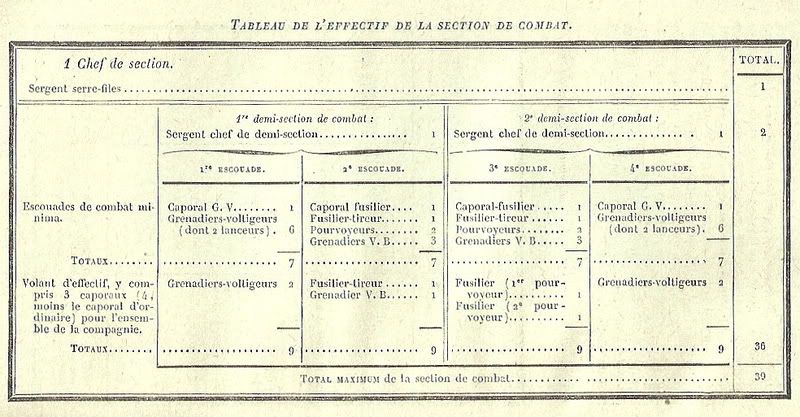
Click to view larger version.Section (2 half-sections) Commanded by 1 lieutenant (or adjudant) and 1 file-closer sergeant
1st Half-Section (2 squads) Commanded by 1 sergeant
1st Squad (Grenadiers):
1 grenadier corporal, 2 throwers, 2 ammo suppliers, 2 assistants, 2 "floater" grenadiers (7-9 men)
2nd Squad (Automatic-Riflemen/V.B. Grenadiers):
1 fusilier corporal, 1 gunner, 2 ammo suppliers, 3 V.B. rifle-grenadiers, 1 "floater" gunner and 1 "floater" ammo supplier or V.B. rifle-grenadier (7-9 men)
2nd Half-Section Commanded by 1 sergeant
3rd Squad (Automatic Riflemen/V.B. Grenadiers):
1 fusilier corporal, 1 gunner, 2 ammo suppliers, 3 V.B. rifle-grenadiers, 2 "floater" assistants (7-9 men)
4th Squad (Vaulters):
1 fusilier corporal, 2 V.B. rifle-grenadiers, 2 ammo suppliers, 2 assistants, 2 "floater" assistants (7-9 men)
October 1918 to November 1918
At the end of the war, the infantry squad was to be done away with entirely. Instead, a section was now composed of 3 combat groups. This change acted to both consolidate the number of effectives in a company and concentrate their fire-power. It was the last stage of evolution: a small, mobile force which was highly adaptive and well armed. Although this organizational change was not widely implemented before the war came to an end.
Section
Commanded by 1 lieutenant (or adjudant) and 1 file-closer sergeant
(3 Combat Groups)
1st Team (Automatic Riflemen):
1 team leader corporal, 1 gunner, 1 ammo supplier, 3 assistants (6 men)
2nd Team (Grenadiers):
1 grenadier corporal, 2 throwers, 2 ammo suppliers with 1 rifle-grenade launcher, 1 extra grenadier (6 men)
Sources:
Bouchery, P. and F. Vauvillier. "1916, Le Poilu de Verdun." Militaria Magazine no. 39 (Nov. 1998): .
British General Staff, ed. French Trench Warfare, 1917-1918: A Reference Manual. Battery Press: Nashville, 2002.
Grand Quartier Général, 3e Bureau. Manuel du Chef de Section d'Infanterie. Jan. 1918 ed. Imprimerie Nationale: Paris, 1918.
Sheffield, Gary, ed. War on the Western Front: In the Trenches of World War I. Osprey Publishing: Oxford, 2007.
Sumner, Ian and Gerry Embleton. The French Army 1914-1918. Osprey Publishing: Oxford, 1999.
Vauvillier, François. Nos Poilus de 1914-1918: L'Infanterie. Histoire & Collections: Paris, 2006.

