



Common Stamps and Markings
This page covers the common stamps applied to the uniform and equipment items distributed to the soldier. Only ink stamps will be covered and not the punched stamps applied on leather equipment with steel punchers. Included are brief descriptions of each stamp along with where the stamp was placed on the items, respectively. All images below are reproductions of originals.
The manufacturer’s stamp was the only one not applied by the army. The unit designation (e.g. regiment) stamp was applied by a quarter-master at the unit level, while the company number/letter and the soldier’s serial number were applied by a quarter-master at the company level. Before being issued, all items were designated collection no. 1, distinguished with a roman numeral “I”. In theory, this stamp along with the company number/letter and soldier’s serial number were not applied directly to clothing items but to a piece of cloth temporarily sewn onto the interior liner of the item. Upon being issued to the soldier, the item is designated as collection no. 2 and distinguished with a roman numeral “II” and same stamps just mentioned were applied directly to the interior liner of the item.
Application of Stamps
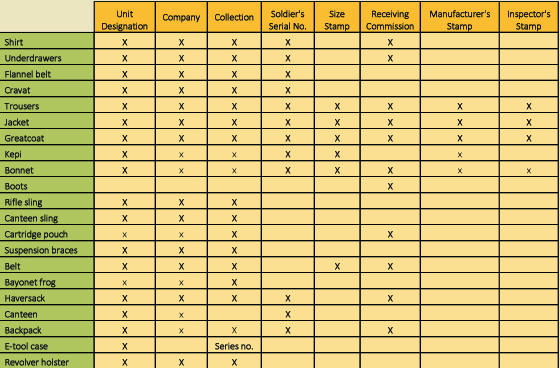
The following table indicates the theoretical application of stamps on the most common uniform and equipment items as set out by the regulations. In practice, however, many items would not necessarily receive all of the stamps they were supposed to have and it was common for many to receive some of these stamps and not others. The exceptions to this were the greatcoat, jacket and trousers, which consistently received all of the stamps.
As an indication of theory vs. practice, in the table an "X" indicates stamps that more often than not were applied per the regs, while an "x" indicates stamps that in practice do not appear to have always been applied.
Stamps
Cachet de la Commission de Réception ("Receiving Commission")
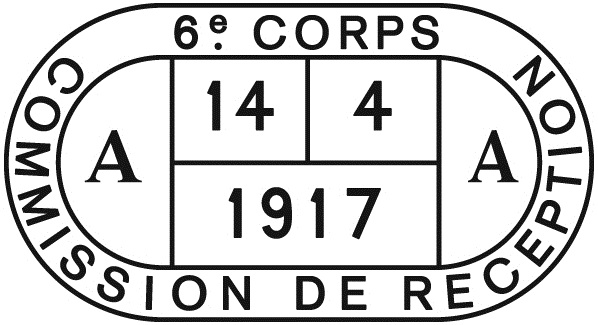
Around the circumference is the army corps/military region that the article is issued to, in this case the 17e Corps ("17th Corps"), which was based in Toulouse. Also, in the circumference, Commission de Réception ("Receiving Commission"). The left and right flanking boxes denote, respectively, the army corps region (A) and region subdivision (A) in which the article is made. The inside boxes denote the date of issue. The top two boxes are the day (14) and month (8), respectively, and the bottom box is the year (1896). In this case then the issue date is August 14, 1896.
The size of the stamp is 5 cm in width and 3 cm in height. This stamp is very common and can be normally found on trousers, under clothing, knapsacks, cartridge boxes, greatcoats and jackets. For the latter two articles, the stamp is placed on the lower left side of the liner.
Cachet de Fournisseur ("Manufacturer's Stamp")


Two examples of manufacturer stamps. On the top of the outside loop is the manufacturer's name, Froment for the example on the left and Hubert de Vautier et Fils on the right. On the bottom is the military region the article was produced in. Here, the region is Besançon and Marseille, respectively. The inner compartments denote the date of manufacture and the bottom two, the receiving commission's serial number. For the Froment stamp, the date is shown in the top compartments, with the month on the left and the year on the right: 2 | 16 means February 1916. The receiving commission's serial number is C 12. Alternately, the serial may be composed entirely of numbers with no letters.
The size of the stamp varies but is generally between 4-6 cm in diameter. This could be smaller for items like kepis and caps though. This stamp is normally found on uniforms, including trousers, greatcoats, and jackets. For the latter two articles, the stamp is placed on the back area of the liner with the size stamp above it.
Cachets de la Taille ("Size Stamps")
Greatcoat:
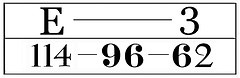
In the top half of the stamp is the size type (E) of the article and the (army corps) region's subdivision (3). In the bottom half of the stamp are the measurements (in centimeters) of the coat. The first is the shoulder width (114), the second is the chest width (96) and the third is the sleeve length (92). The stamp is placed on the back area of the liner with the manufacturer's stamp below it.
Trousers:
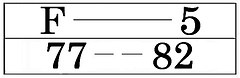
In the top half of the stamp is the length type, expressed in letters (A-I). This is the measurement of the outter seam, from the waist to the cuff. The number next to it is the waist measurement, expressed in numbers (1-5). In this case, the seam length and waist is: (F 5). In the bottom half of the stamp are the measurements (in centimeters) of the trousers. The first is for the hips (77) and the second for the waist (82).
The size of the stamp is 10 cm in width and 4 cm in height. As indicted above, the top stamp is found on greatcoats, the bottom one on trousers (or culottes).
Cachet d'Expert ("Inspector's Stamp")
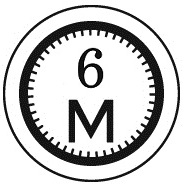
On the top is the inspector's army corps region, in this case 6. On the bottom is the inspector's serial letter, in this case M.
The size of the stamp is roughly 1.5 cm in diameter. This stamp is normally found on uniforms, including trousers, greatcoats and jackets. For the latter two articles, the stamp is placed on the lower left side of the liner.
Marquage du Régiment ("Regiment Marking")

Also known as the unit designation marking, this stamp showed the regiment's number and type (e.g., line, reserve, territorial, etc.). In lieu of a cast stamp, a soldier might inscribe the number and type himself using a pen. In the case here, it is the 151e de L[igne] or the 151e Régiment d'Infanterie de Ligne ("151st Line Infantry Regiment").
The length of the stamp differed depending on the regiment's number and the style of the stamp. A stamp with as many as three digits was a little under 5 cm in length. The stamp is normally around 2.5 to 3 cm in height. The reproduction "151e de L" stamp above is exactly 4.4 cm x 2.2 cm. The unit designation stamp was one of the most common found and can be normally found on greatcoats, trousers, jackets, under clothing and knapsacks, among other things.
Marquage du Numéro Matricule du Soldat ("Soldier's Serial Number Marking")
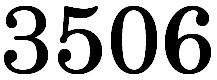
This stamp is the soldier's personal serial number (i.e. the matriculation number) and is normally composed of three or four digits. Note this is not the soldier's personal recruitment number, which is basically the new recruits draft number. The soldiers serial no. is the one that appears on his ID tags and his individual soldier's booklet. In lieu of a stamp cast, a soldier might inscribe the number himself using a pen. In this case, the soldier's number is 3506.
While the size (especially the length) of this stamp differed, it is normally between 2-3 cm in height. The stamp was very common and can be found on all uniform items and equipment, including small items such as socks, wash towels and ration and utility baggies.Stamp Placements
The following instructions are based on prescribed regulations stipulating the exact arrangement of the stamps discussed above and the location of where they are to be applied on the item. In practice, these were not always closely adhered to and alternatives placements are noted based on evidence found on existing originals. Also, as noted before the table above, in practice many items would not necessarily receive all of the stamps they were supposed to have and it was common for many to receive some of these stamps and not others. The exceptions to this were the greatcoat, jacket and trousers, which consistently received all of the stamps. A special note about the manufacturer's stamp and reception commission stamp: the regs do not mention these stamps. The manufacturer's stamp was not applied by the quarter-master but at the clothier. The reception commission stamp was but is nonetheless not mentioned. Placement instructions for these stamps are therefore based on observation of original items.

Uniform
Greatcoat:
The company, collection and serial number stamps were placed in a double line, one above the other. In the top line, the company number/letter followed by the collection number. In the bottom line, 10 mm below the top line, the soldier's serial number. Example:
These stamps are applied to the left side of inside liner, with the serial number placed about 15 centimeters above the belt and 5 cm from the vertical dressing. Across from this on the right front of the liner, in a location corresponding to the company, collection and serial no. markings, the regiment stamp was applied.4 II
935
Note: if it was necessary to apply a new stamp (i.e. the item is reissued), the old stamp would be struck through and the new stamp applied, and zeros stamped over any numbers. In practice, more often than not the old stamp was simply struck through and it was left at that. The new stamp was then normally applied above or below the old one.
For the remaining stamps, the regs do not address the placement. Instead, this information is taken from observation of originals. The manufacturer's stamp was normally applied on center (back) of the liner, either directly in the middle or towards the top of the back. The size stamp was normally applied either above or below the manufacturer's stamp. The location of the reception commission stamp varied but was often placed either on the left or right front side of the liner, or on center (back) near the size and manufacturer stamps. The inspector's stamp was normally placed near the reception commission stamp.
Jacket/Tunic:
For the M1870 jacket, M1897 tunic, and later the M1915 jacket, stamp arrangement and location are virtually identical to the greatcoat. The only distinction is that the soldier's serial no. is situated 12 cm from the bottom edge of the jacket/tunic. The exception to this the M1914 jacket, which did not have a complete liner. In this case, most of the stamps were applied on the interior canvas chest-pockets.
Trousers:
The regiment stamp, and company number/letter followed by the collection number, were placed beside each other and were applied to right front side of the interior waistband, parallel to the length. In the corresponding location on the left front side of the waistband the soldier’s serial no. was applied. The size stamp was applied to the back left side of the interior waistband, while the manufacturer’s stamp was applied to the either the left or right button reinforcement sewn below the back waistband. The placement of the reception commission stamp varied but was normally applied either to the interior waistband or to the fly liner or pocket liner. The inspector’s stamp was normally located near the reception commission stamp.
Kepi:
The company number/letter followed by the collection number and below it, the soldier's serial no. These are applied to the piece of canvas cloth located behind the disc-shaped flap in the leather liner of the kepi. In practice, stamps were also applied to the reverse side of this flap. Sometimes the only stamp applied was the serial no. with the company or collection number. A size stamp and a small manufacturer's stamp was often applied to these same areas as well. Of note here is the practice soldier’s sometimes took upon themselves to inscribe their name in ink on the inside of the kepi (normally just the last name, though occasionally both first and last with the first name often abbreviated). There is little evidence of the reception commission stamp being applied to a visible area of the kepi liner, though it potentially could have been placed on the interior of the sweatband.
Bonnet:
The regiment stamp, and company number/letter followed by the collection number, are normally applied beside each other on one side of the interior sweatband. The soldier’s serial no. and reception commission are often placed on the opposite side of the sweatband, along with the inspector’s stamp and a size stamp. A small oval-shaped manufacturer’s stamp sometimes is applied to the sweatband as well. Like the kepi, soldier’s sometimes took it upon themselves to inscribe their name in ink on the bonnet sweatband (normally just the last name, though occasionally both first and last with the first name often abbreviated).
Small Equipment
Shirt:
The regiment stamp, and company number/letter followed by the collection number on the top line, with the soldier's serial no. below this. These were applied to the left breast, about 50 mm from the vent opening. The reception commission stamp does not appear to have been commonly applied to the shirt but when it was it was applied to the right breast, in the corresponding location opposite the stamps on the left breast. Alternatively, it potentially could have been applied to the interior.
Underdrawers:
The regiment stamp and reception commission stamp were applied to the inside front of the underdrawers, where the fabric is doubled. The soldier’s serial no. was applied normally to the outside front of the underdrawers.
Flannel belt:
On the M1905, the stamps are applied in three lines. On top, the regiment stamp is centered between the suspender buttons, parallel to the top edge. Below this is the company number/letter followed by the collection number. On the third line below these, the soldier's serial no. On the war-time (long) flannel belt wrap, often just the serial no. is found at one end or the other.
Cravat:
The regiment stamp is applied to the inside of one end of the cravat, while the soldier’s serial no. was applied to the inside of the other end.
Large Equipment
Rifle sling:
The regiment stamp and then the company number/letter followed by the collection number, were placed along the reverse side of the sling, parallel to its length. The regiment stamp was to be applied 3 cm from the buckle end of the sling. The reception commission stamp does not appear to be commonly applied to the sling.
Suspension braces:
Stamp arrangement is identical to the rifle sling. The stamps were to be applied to the inside of the right strap, 3 cm from the metal ring joining the straps. The reception commission stamp does not appear to be commonly applied to the straps.
Cartridge pouch:
The regiment stamp, company number/letter and collection number were place in a double-line, one above the other. On the top line was an abridged version of the regiment stamp (e.g. 151e). Below it was the company number/letter followed by the collection number. These were applied on the inside center of the cartridge pouch front flap. The reception commission stamp was sometimes applied to the inside of the cartridge pouch front flap as well.
Belt:
The regiment stamp (abridged version) was placed parallel to the length of the belt. To the left of it and placed perpendicularly was the company number/letter and collection number. To the left of this was the soldier's serial no. placed parallel to the length. These were applied on the inside of the belt, towards the buckle end. On the opposite (raw) end of the belt, the belt size (in cm) was stamped. The reception commission stamp was applied indiscriminately along the inside length of the belt.
Revolver/pistol holster:
Stamp arrangement and placement is virtually identical to the cartridge pouch. The stamps are applies to the inside bottom of the flap cover. The reception commission stamp was sometimes applied to the inside of the flap cover as well.
Canteen cover:
Like the kepi, soldier’s sometimes took it upon themselves to inscribe their name in ink on the piece of cloth sewn to the bottom of the canteen (normally just the last name, though occasionally both first and last with the first name often abbreviated). The reception commission stamp does not appear to be commonly applied to the canteen cover.
Canteen sling:
The regiment stamp and then the company number/letter followed by the collection number, were placed along the reverse side of the sling, parallel to its length. The regiment stamp was to be applied 3 cm from the buckle end of the sling. The reception commission stamp does not appear to be commonly applied to the sling.
Backpack:
All stamps are applied to the interior liner of the main pack flap and parallel to the bottom edge. The company number/letter followed by the collection number are placed to the right of the vent (forming the pocket) and below it, the soldier's serial no. The regiment stamp is placed to the left of the vent. Like the kepi, soldier’s sometimes took it upon themselves to inscribe their name in ink on either the outside or the inside the pack’s main flap (normally just the last name, though occasionally both first and last with the first name often abbreviated). The reception commission stamp was applied indiscriminately to the interior line of the main pack flap.

